
Why Rust Is the Future of Mobile App Development: Performance, Safety, and Speed?
Oct. 29, 2025
2165

Table of Contents
In today’s fast-paced world of mobile apps, developers and businesses face three big challenges: speed, reliability, and security.
If you want your app to load quickly, run smoothly, handle many users without crashing, and stay protected from attacks, you need a solid foundation. That’s why the programming language you choose is more important than ever. When it comes to Rust, it’s growing in popularity as a language that combines high-performance system-level capabilities with safety and modern features.
In this article, we’ll take a closer look at why Rust is becoming a top choice for mobile app development, especially if you care about performance, safety, and speed, and why this makes it a strong candidate for the future of mobile apps. We’ll break it down into three simple ideas: performance, safety, and speed.
Let’s dive in without wasting any time.
Performance That Speaks for Itself
Nobody likes a slow mobile app. Whether it’s a game, a shopping app, or a social media platform, users expect smooth performance and fast responses. Rust helps developers achieve exactly that. Unlike many modern programming languages, Rust doesn’t use a garbage collector. That means your app doesn’t pause to clean up memory while running, it keeps going smoothly. It gives you the same raw speed as C or C++ but with much better safety.
When developers say Rust is the future of mobile app development, they’re often talking about its unmatched performance. Have a look at some stats.
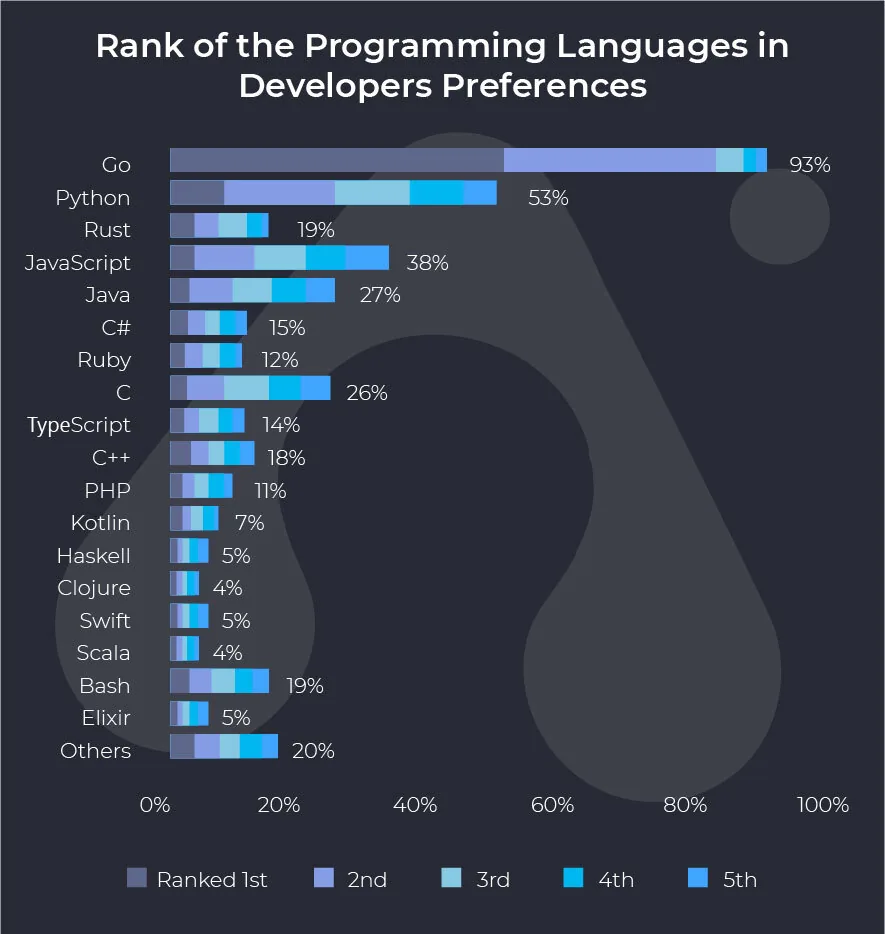
Apps built in Rust start up quickly, run efficiently even on older phones, and use less battery—all thanks to its smart memory management and low overhead.
Unmatched Safety
Speed alone isn’t enough. A fast app that crashes isn’t a good app. That’s where Rust’s safety features really shine. Rust’s main promise is memory safety—meaning it protects your app from common bugs that lead to crashes, leaks, or security issues. Other languages may let you accidentally access data that’s already gone or share it incorrectly between threads, but Rust’s system simply won’t allow that to happen.
Speed of Development
There is more to speed than just how quickly your software operates. It also has to do with how quickly you can construct and enhance it. Rust also aids in that. Rust saves time and effort by enabling developers to write shared logic that functions on both iOS and Android. It is not necessary to write the same code twice, once for Kotlin and once for Swift. Alternatively, you can use Rust to develop your primary codebase and link it to both platforms.

Because it enables them to deploy updates more quickly, correct bugs more quickly, and maintain a single, robust, secure codebase for numerous platforms, development teams are claiming that Rust is the future of mobile app development.
Key Takeaways
| Key Point | Explanation |
|---|---|
| 1. High Performance | Rust apps run fast, use less battery, and stay smooth on all devices. |
| 2. Safe and Secure | Rust prevents crashes and protects apps from memory and security issues. |
| 3. Faster Development | One Rust codebase can work for both Android and iOS, saving time. |
| 4. Cross-Platform Support | Rust allows sharing app logic across mobile and web platforms. |
| 5. Future-Ready | Rust combines speed, safety, and reliability—making it ideal for modern app development. |
Overcoming the Hurdles
Of course, every new technology has its challenges. Rust's syntax and ideas like ownership and borrowing might feel tricky at first. Developers need some time to learn before they feel confident using it. Also, the Rust ecosystem for mobile apps is still growing. While it's great for handling the main logic, creating full mobile apps entirely with Rust is still in the early stages. But as the community grows and tools get better, these problems are being fixed fast. The small amount of learning you need now is well worth it, because of the long-term benefits in safety, speed, and efficiency. That's why experts think Rust is the future of mobile app development.
Real-World Benefits Developers Love
Developers who have moved to Rust for building mobile apps often talk about these real advantages:
Battery-friendly apps: Rust runs efficiently, which means less use of the device’s battery and longer lasting apps.
Crash-free experience: Rust checks for mistakes during the coding process, helping catch issues early on.
Reuse: Use the same Rust code for Android, iOS, or even for projects targeting Web Assembly. Security-first: Rust helps avoid memory leaks and security issues, which helps create more stable applications.
Better Scalabity
Rust is useful for applications that require scaling or handle large workloads. All of these benefits ultimately lead to a single idea very clearly: Rust is the next an evolution in mobile application development. It empowers developers to easily write better, higher performing, and safer applications.
Why is Rust growing popular for mobile app development? Rust is increasingly become a preferred developer language because it provides speed, safe and reliability which are three critical factors when it comes to mobile application development. Developers love using Rust because it builds applications that run faster and have less crashes. These are the key reasons many in the professional sector believe that Rust is next in mobile application development?
Read more about Why Choose Rust for Mobile App Development?
Can I use Rust for both Android and iOS apps?
Yes, you can. Rust allows you to reuse a common core codebase for both Android and iOS applications. The user interface can be build using native languages, like native Swift for iOS, native Kotlin for Android, and the majority of your core logic can be built using Rust, which improves development time, reduce errors, improve performance.
Conclusion
To conclude the discussion, I want to say that the mobile app world is changing rapidly, and developers need tools that can keep up.
Rust is fast, safe, and efficient, the perfect mix for building next-generation mobile apps. While it might take a little time to learn, the rewards are huge: stronger security, better performance, faster development, and happier users.
In short, Rust allows us to build high-quality mobile apps for iOS and Android without compromise. It’s fast, safe, and perfect for apps that need performance.
So, if you’re thinking about taking your mobile app to the next level, why not give Rust a try? It might just revolutionize the way you build apps!
At CodeSuite, we’re always looking for new ways to push the boundaries of mobile app development services. Want to see what Rust can do for your next app? Let’s talk!